Saying Goodbye to Aquarius
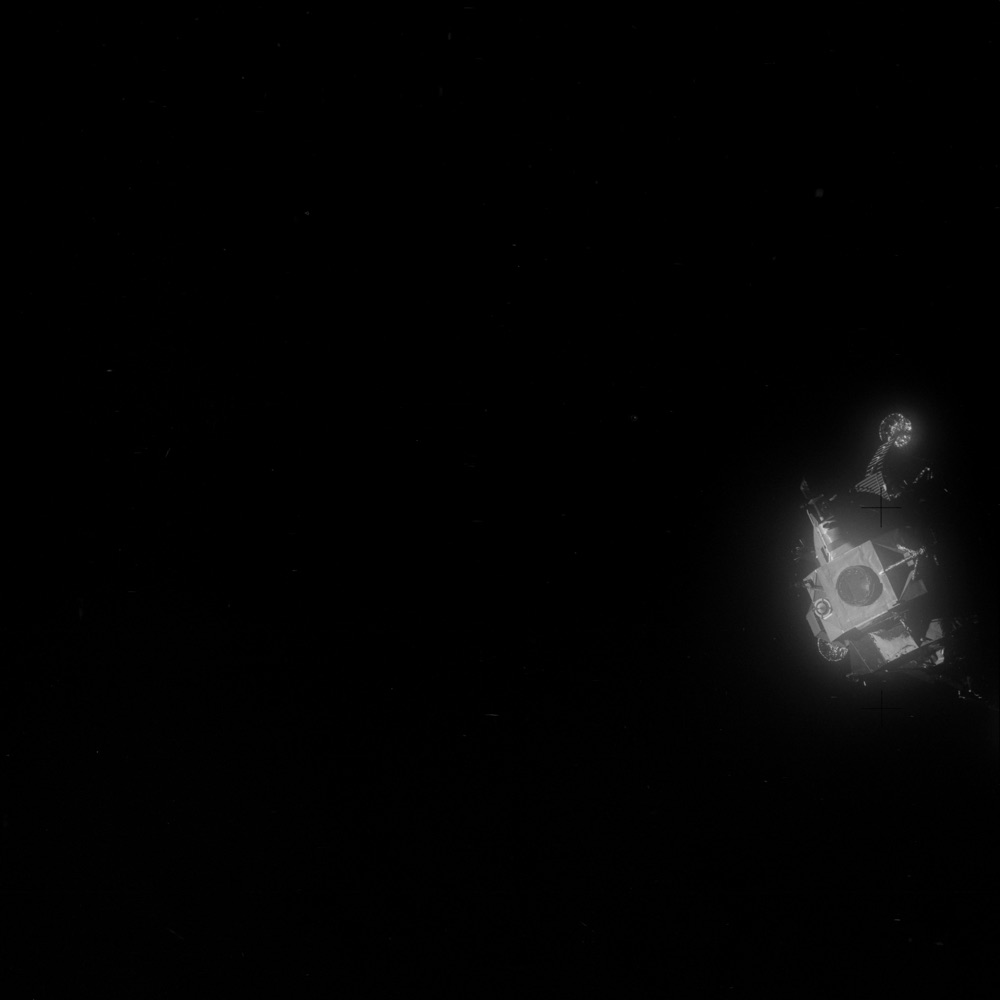
The Lifeboat That Saved Them
For almost four days — about 84 hours — the Lunar Module Aquarius was home. Cramped, cold, and miserable. But it kept three men alive on a ship designed to support two men for 45 hours.
Its batteries ran the whole lifeboat. Its water cooled the electronics. Its descent engine fired every burn that bent their path home. And taped into its cabin was the cardboard "mailbox" that scrubbed the deadly CO2 out of their air.
Aquarius was never designed to be a lifeboat. It became one anyway.
Why Leave It Behind?
Aquarius had no heat shield. In the fire of re-entry it would burn up like a meteor. Only the Command Module Odyssey — with its ablative heat shield, its blunt aerodynamic shape, and its parachutes — could carry the crew through the atmosphere.
Bottom line: to get home, they had to let the lifeboat go.
The Final Transfer
One last float through the tunnel. The crew carried their exposed film, flight logs, and hand-written calculations into Odyssey. They left behind the tools, the leftover food and water, the mailbox — and the landing gear that would never touch the Moon.
Lovell, the last man out, took a final look around the frost-lined cabin and sealed the hatch.
GET 141:30:00 - LM Jettison
Here's the clever part: nothing "pushed" Aquarius away — no springs, no thrusters. The crew simply left air pressure trapped in the docking tunnel. When the pyrotechnic charges cut the two ships apart, that trapped air did the work, popping Aquarius loose like a cork from a bottle.
GET 141:29:51 — Jack Swigert: "10 seconds."
GET 141:29:56 — Jim Lovell: "Five. LM jettison."
BANG! The pyros fired. Aquarius drifted free.
Houston's Farewell
"Farewell, Aquarius, and we thank you."
— CAPCOM Joe Kerwin, Mission Control, GET 141:30:05The famous goodbye didn't come from the crew — it came from the ground. Joe Kerwin, the astronaut at the CAPCOM console in Houston, radioed it up seconds after Lovell's "LM jettison" call. An hour later, Lovell added his own quiet goodbye: "She sure was a good ship."
Read the full exchange in the Apollo 13 Flight Journal.
What Happened to Aquarius?
Through Odyssey's windows the crew watched Aquarius tumble slowly away, its foil skin flashing in the sunlight until it was just a dot against the black. With no heat shield, it broke up and burned in the atmosphere; the pieces that survived fell into the deep Pacific near the Tonga Trench. Nothing was ever recovered.
The lifeboat that saved three lives lasted exactly as long as it had to.
The Numbers
Aquarius's Service Record:
⏱️ Time as lifeboat: ~84 hours (designed to run 45)
👨🚀 Crew supported: 3 astronauts (designed for 2)
🚀 Burns: every one it was asked for — free-return, PC+2, and the mid-course corrections
💨 Oxygen: never ran low — 28.5 pounds still aboard at jettison, more than half the post-explosion supply
🔋 Power: ~80% of battery capacity used, ~20% margin left — a margin earned by the brutal power-down
💧 Water remaining at jettison: ~28 pounds (about 3.4 gallons)
❄️ Cabin temperature: ~49°F — cold enough to see your breath, but warmer than the 38°F Command Module
✅ Crew brought home alive: 3 of 3
🌟 Thank You, Aquarius
You were built to land on the Moon.
When the mission changed, you became a lifeboat instead.
You kept three men alive when nothing else could.
That's a pretty good mission, Aquarius.
⏰ Status: 70 Minutes to Re-Entry
Current time: GET 141:30:00
Re-entry begins: GET 142:40:46 (70 minutes away)
Splashdown: GET 142:54:41 (~84 minutes away)
Aquarius: Jettisoned ✓
Odyssey: Powered up, flying on its own batteries
Next: hitting the atmosphere at 24,000+ mph