Preparing for Re-Entry
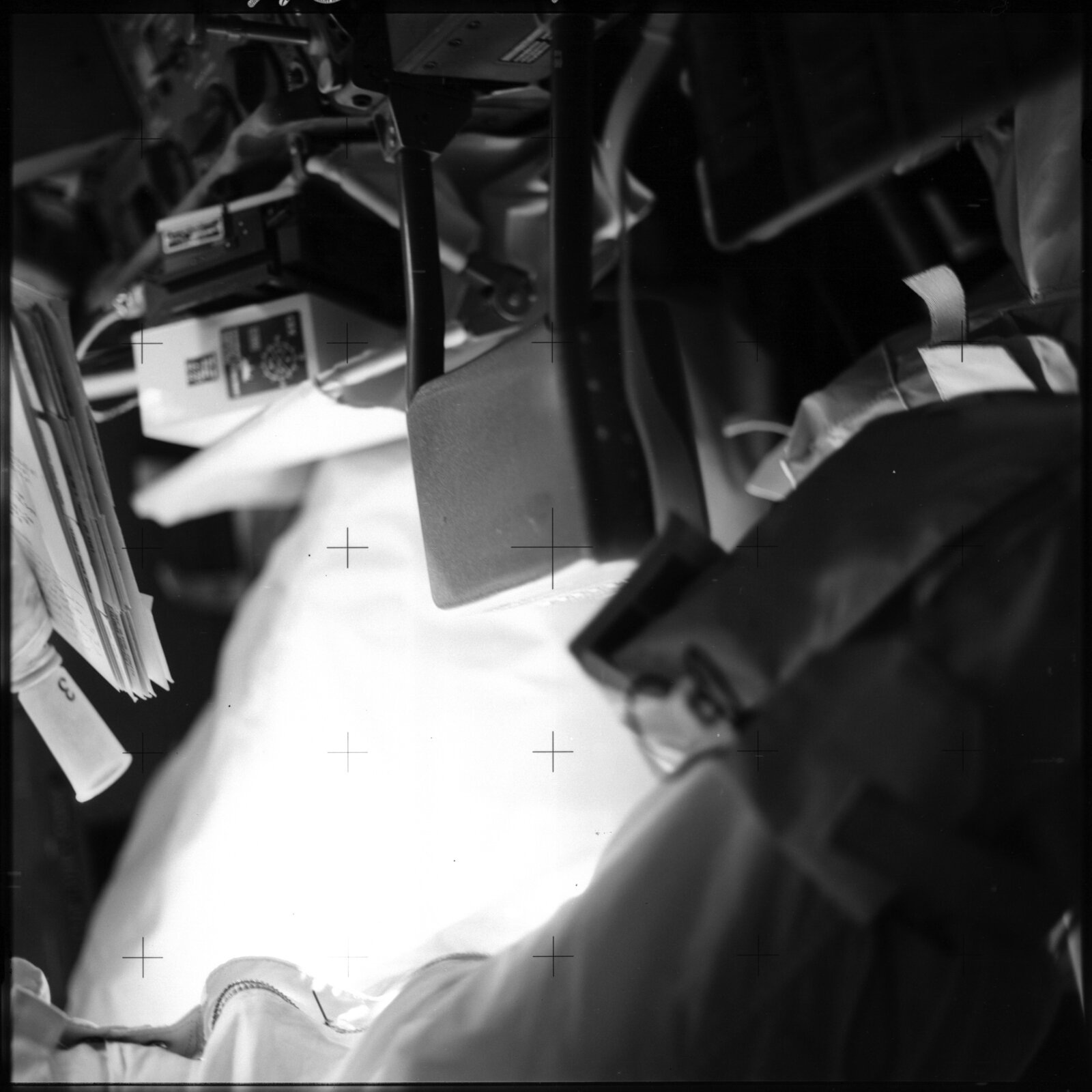
"You're Go to Start Powering Up"
Odyssey had been dark for 81 hours — three and a half days at 38°F, every surface dripping with condensation. No spacecraft had ever been shut down and brought back to life in flight. At GET 140:09, with about two and a half hours left before Apollo 13 hit the atmosphere, Houston made the call.
KERWIN (Mission Control): "Okay. You're Go to start powering up the Command Module."
LOVELL: "Right-o. We're starting now."
— Mission transcript, GET 140:09:52 (Apollo 13 Flight Journal)
⏰ The Final Hours:
- GET 138:02 — Service Module jettisoned; the crew photographs the damage
- GET 140:10 — Command Module power-up begins (about 2½ hours before entry)
- GET 141:30 — Lunar Module jettison (next slide)
- GET 142:40:46 — Entry interface: Odyssey meets the atmosphere
- GET 142:54:41 — Splashdown
Full Batteries — For Once, Good News
For four days the crew had rationed every amp. Now that discipline paid off: the Lunar Module had spent hours trickle-charging Odyssey's entry batteries through a jury-rigged reverse of the docking umbilical. At power-up they held about 118 of 120 amp-hours — "within 2 amp-hours of the lift-off number," Mission Control reported. A normal entry used roughly 70 to 80. After days on the edge, Apollo 13 was going into entry with real margin.
What no one could promise: that power would flow through those soaked panels without a short circuit.
Switch by Switch
Jack Swigert worked down the checklist he had copied by hand, Lovell confirming each step. Every switch throw carried the same risk: current through a wet panel could arc, blow components, and end the restart minutes after it began.
The arc never came. The heavy insulation engineered into the Command Module after the Apollo 1 fire held. In Lovell's words: "no arcing took place."
- Main buses live. Eyes locked on the current meters, watching for the spike that would mean a short. Readings: normal.
- Guidance platform up. No time to align from scratch — the crew transferred the alignment from Aquarius's still-running platform, then checked it against the stars (Houston suggested Vega and Altair).
- Computer on. Its magnetic-core memory had survived the shutdown untouched (see previous slide). Houston dumped it over telemetry to be sure.
- Fresh entry data in. Position, velocity, splashdown target — radioed up, typed into the computer, read back, verified.
KERWIN: "And, Odyssey, Houston. The computer is yours. You can press on."
— GET 140:41:25
The Crew at the Edge
They had been in space almost six days — the last four cold, wet, thirsty, and nearly sleepless. Lovell lost 14 pounds on the flight; the crew together lost 31.5, nearly 50 percent more than any other Apollo crew. Fred Haise was in the worst shape, shivering through a kidney infection with a fever climbing toward 104°F. And Jack Swigert — who had thrown the routine switch that triggered the explosion, through no fault of his own — now had to execute hundreds of restart steps without a single mistake.
He didn't miss one.
What They Still Couldn't Know
- ⚠️ The heat shield. Had the explosion damaged it? There was no way to inspect it. They would find out in the fire of entry.
- ⚠️ The parachutes. Cold-soaked for days in the nose of the CM. Would they deploy?
- ⚠️ The frozen electronics. Booting up gently was one thing. Surviving entry vibration and crushing g-forces was another.
They had done everything that could be done. The rest they would learn the hard way.
ODYSSEY IS ALIVE
Entry was closing in — and one farewell remained.
Aquarius, the lifeboat that had kept them breathing for four days, was still docked.
It was time to let her go.