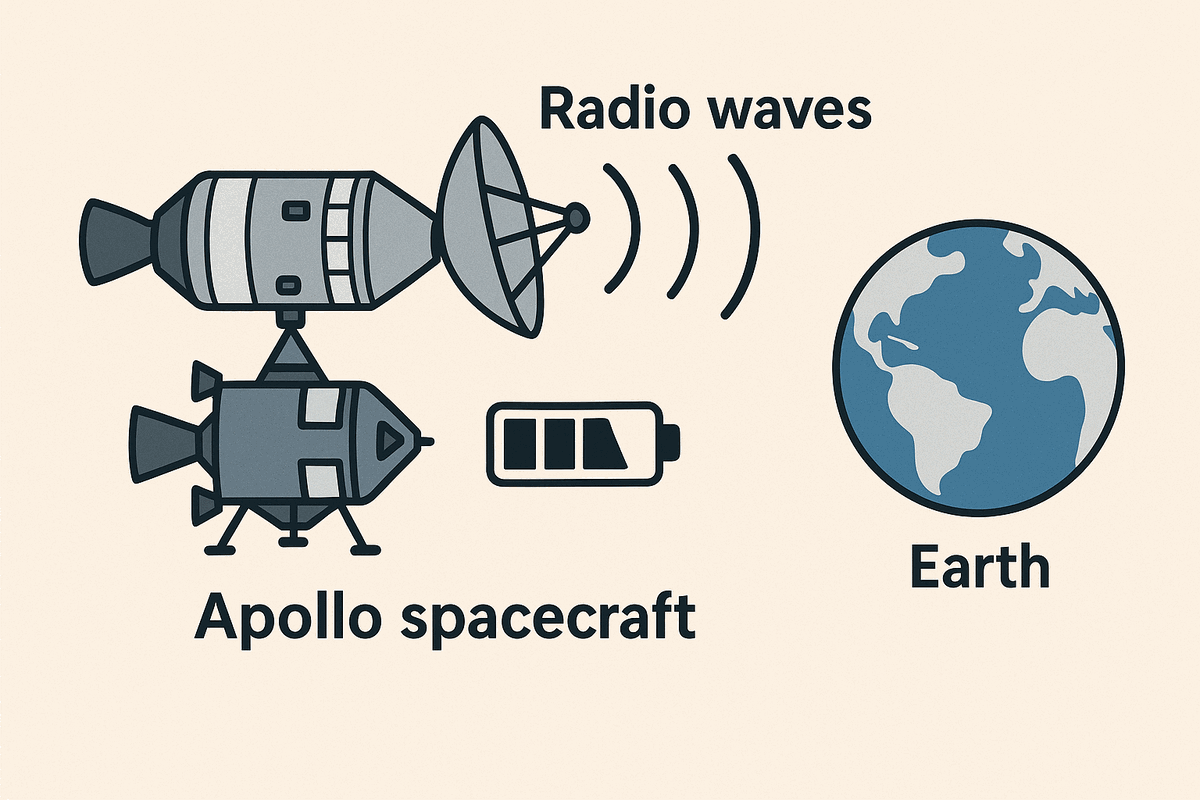
✓ LOW-POWER COMMS
As part of the massive powerdown after the free-return burn, Houston configured Aquarius's radios for maximum stinginess: S-band transceiver on low power, power amplifier off, omni antennas, low-bit-rate telemetry, ranging off. But voice stayed on.
What Actually Happened:
- Voice contact was essentially continuous the entire way home—the only real gaps were about 25 minutes passing behind the Moon and the radio blackout of re-entry
- There was never an hours-long radio silence. Houston and the crew talked around the clock, on a whisper of power
- The signal got scratchy at times, and the crew had to swap omni antennas as the ship rotated—but the link home never went dark
The Families Could Listen In:
NASA had installed "squawk boxes"—small speakers carrying the live air-to-ground radio loop—in the astronauts' homes. Marilyn Lovell and the other families could hear the crew's actual voices all the way back. Continuous comms weren't just good engineering; they let the families hear proof, hour after hour, that the crew was still alive.
The Power Payoff:
Result: The Batteries Made It—With Margin
Low-power comms was one piece of a total powerdown that cut the LM to roughly 20% of its normal electrical load.
At LM jettison: about 20% of the 2,181 amp-hours still remained—a hard-won reserve.
Why it was the right decision: Low-bit-rate telemetry still gave Houston the handful of numbers that really mattered, and voice cost little. A weak-but-continuous link beat a strong link attached to dead batteries. In a power crisis, you don't shout—you whisper, and you never stop talking.
📚 Sources for Skeptics
Think full-power telemetry was worth the amps? Don't take our word for how it really went—checking the record is exactly how engineers think. Listen for yourself: