The Unsung Heroes
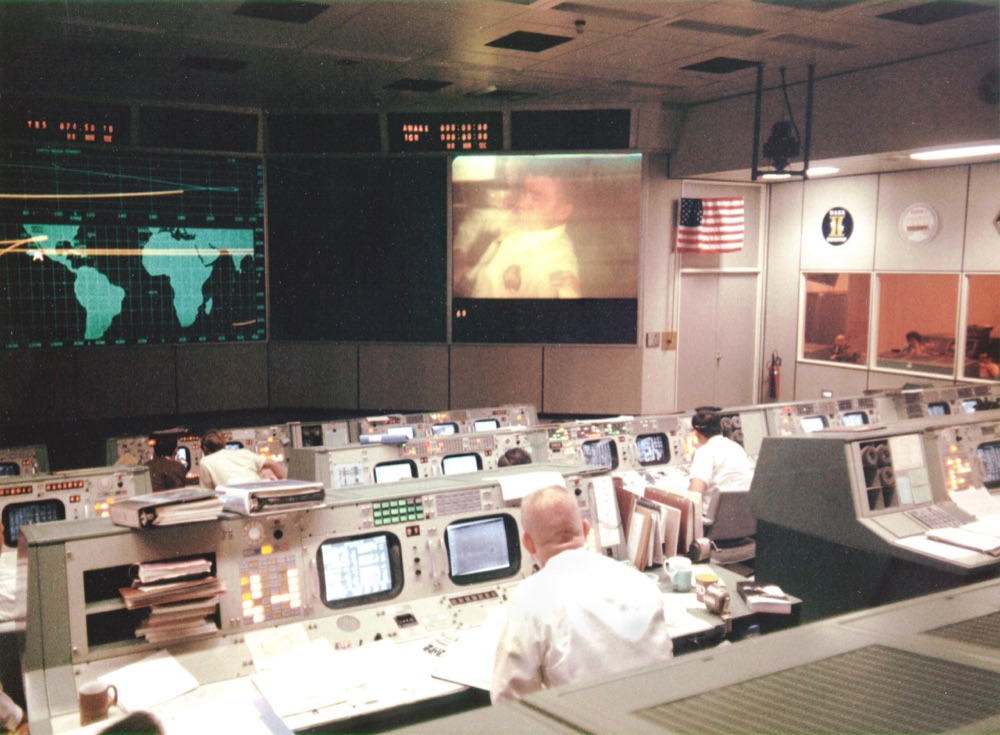
More Than Three Astronauts
Jim Lovell, Jack Swigert, and Fred Haise got the headlines—and earned them. But they came home because thousands of people on the ground spent six days refusing to let them die.
🎮 The Flight Directors — Four Teams, Around the Clock
Gene Kranz — White Team
On console when the tank blew. Kranz steadied the room through the chaotic first hours, then pulled his team off console as the "Tiger Team" to attack the biggest problem of all: stretching the power and reviving a frozen Command Module.
"Failure is not an option"? Kranz never said it during the mission—screenwriters wrote it for the 1995 movie. He liked it enough to title his memoir with it.
Glynn Lunney — Black Team
Took over about an hour after the explosion and ran the shift that moved the crew into the Lunar Module and put Apollo 13 on a free-return path around the Moon. Controllers still call it one of the finest shifts ever flown.
Gerry Griffin — Gold Team & Milt Windler — Maroon Team
Their teams carried the long, cold coast home and built the re-entry plan.
👨💻 The Flight Controllers — The Problem Solvers
Sy Liebergot — EECOM
The electrical-systems controller on duty at the explosion. His screens showed so many simultaneous failures that his first call was instrumentation trouble—no real failure had ever looked this bad. Then the oxygen kept falling.
John Aaron — EECOM
Handed control of every watt on both spacecraft; his tiger team wrote the Command Module power-up sequence. He gets the next slide to himself.
The CAPCOMs — The Voices the Crew Heard
Only fellow astronauts spoke to the crew. The rotation—Joe Kerwin, Jack Lousma, Vance Brand, and grounded crewmate Ken Mattingly—read up thousands of procedure steps, calm on the loop no matter what. It was Kerwin who radioed the farewell as the lifeboat was cast off:
"Farewell, Aquarius, and we thank you." — CAPCOM Joe Kerwin, GET 141:30
Chuck Deiterich — RETRO
The retrofire officer whose team computed the burns that bent Apollo 13's path home and threaded the narrow re-entry corridor.
Deke Slayton — Director of Flight Crew Operations
One of the original Mercury Seven, grounded by a heart condition before he could fly. As the astronauts' boss, he advised on how hard the freezing, exhausted crew could be pushed.
👨🔧 The Engineers — The Inventors
Ken Mattingly — Bumped From the Flight, Hero on the Ground
Days before launch, backup crewman Charlie Duke came down with German measles (rubella)—and blood tests showed Mattingly had no immunity. NASA grounded him; Jack Swigert took his seat. (He never caught it, and later flew to the Moon on Apollo 16.) During the crisis he all but lived in the Command Module simulator, flying the power-up procedures from John Aaron's team until every step worked.
Ed Smylie and the "Mailbox" Team
Smylie, chief of the Crew Systems Division, led the engineers who designed the CO2 scrubber adapter from items known to be aboard—plastic bags, cardboard, hose, duct tape—then had the build steps read up to the crew. Within hours, cabin CO2 fell from a rising ~15 mmHg to under 1 mmHg.
Grumman & North American Rockwell
The builders of Aquarius and Odyssey kept engineers on call around the clock for spacecraft pushed far beyond their design limits. The Lunar Module was rated to keep two men alive for 45 hours; it kept three alive for roughly twice that.
👨👩👧👦 The Families — The Ones Who Waited
Marilyn Lovell
Four children, reporters camped on the lawn, six days of not knowing.
Mary Haise
Three children at home—and pregnant with their fourth—while Fred flew home shivering and running a fever.
The Swigerts
Jack was single; his family in Colorado watched his first spaceflight turn into a fight for his life.
The Team Behind the Team
- 🎮 Four flight-control teams — White, Black, Gold, and Maroon — around the clock
- 🏭 Thousands of engineers at NASA centers and contractor plants
- 📡 A worldwide tracking network and a Navy recovery fleet in the Pacific
- 🏅 The Apollo 13 Mission Operations Team received the Presidential Medal of Freedom
🏆 The Real Heroes
Jim, Jack, and Fred showed incredible courage in space.
But they survived because thousands of people on Earth refused to quit.
Apollo 13 wasn't saved by three astronauts.
It was saved by an army.